
Between finishing a response and the human’s next message, how long does the agent sit idle — and where does total idle time accumulate?
Between finishing a response and the human’s next message, how long does the agent sit idle — and where does total idle time accumulate?
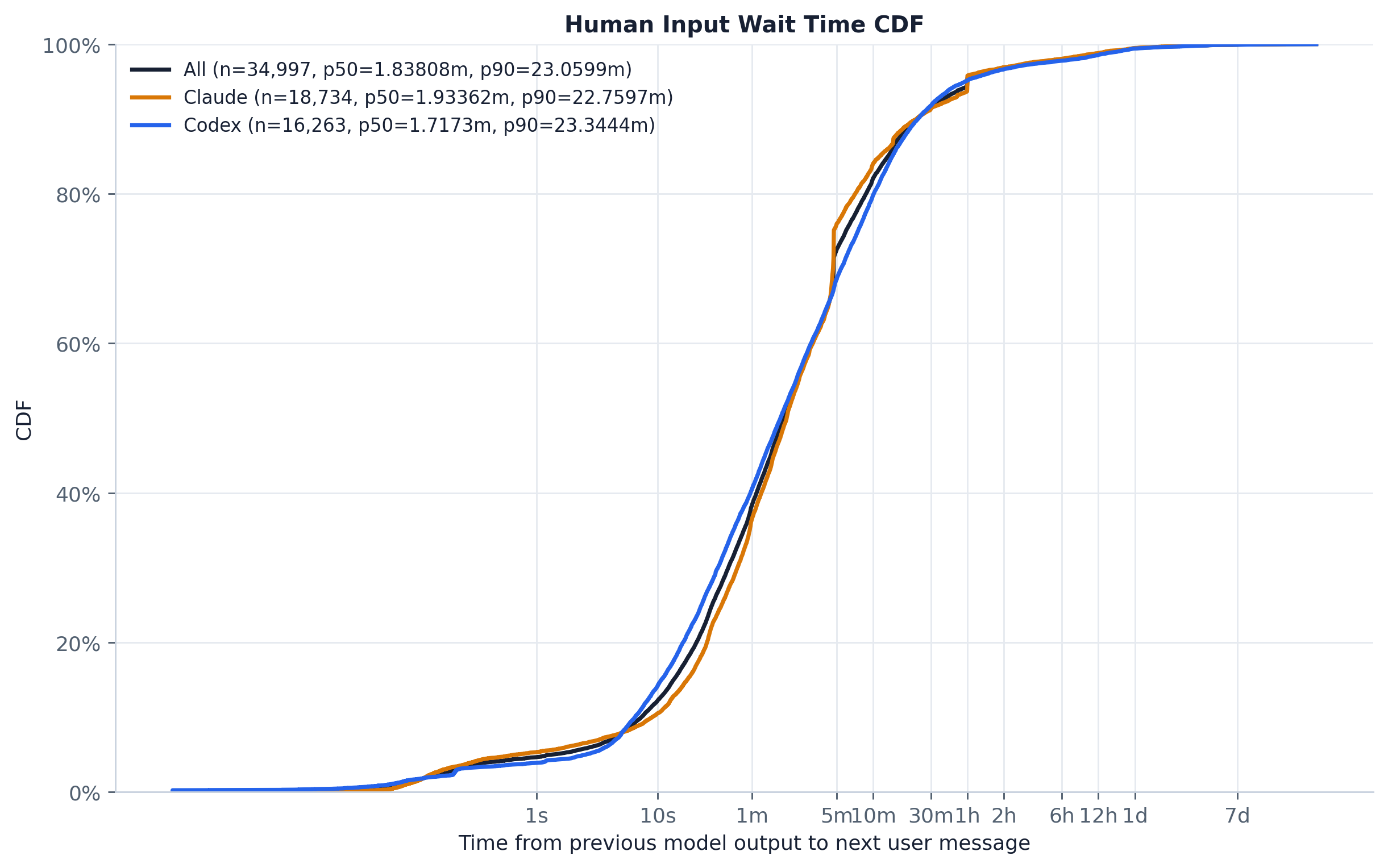
The wait distribution is short at the body but spans seven orders of magnitude into the tail. The median human reply is fast — ~86s overall (Claude p50 120s, Codex p50 59s) — but the curve keeps climbing well past an hour: p90 is ~15 min overall, p99 ~11.2h, and the longest gap is a session resumed ~31 days later. The two providers track closely through the body, with Codex sitting slightly to the left (mean idle 2,325s vs Claude’s 2,406s). Read the height at the 5-minute or 1-hour landmark to see how often the human answers before the prefix cache likely goes cold; the long right tail is sessions left open for hours or days.
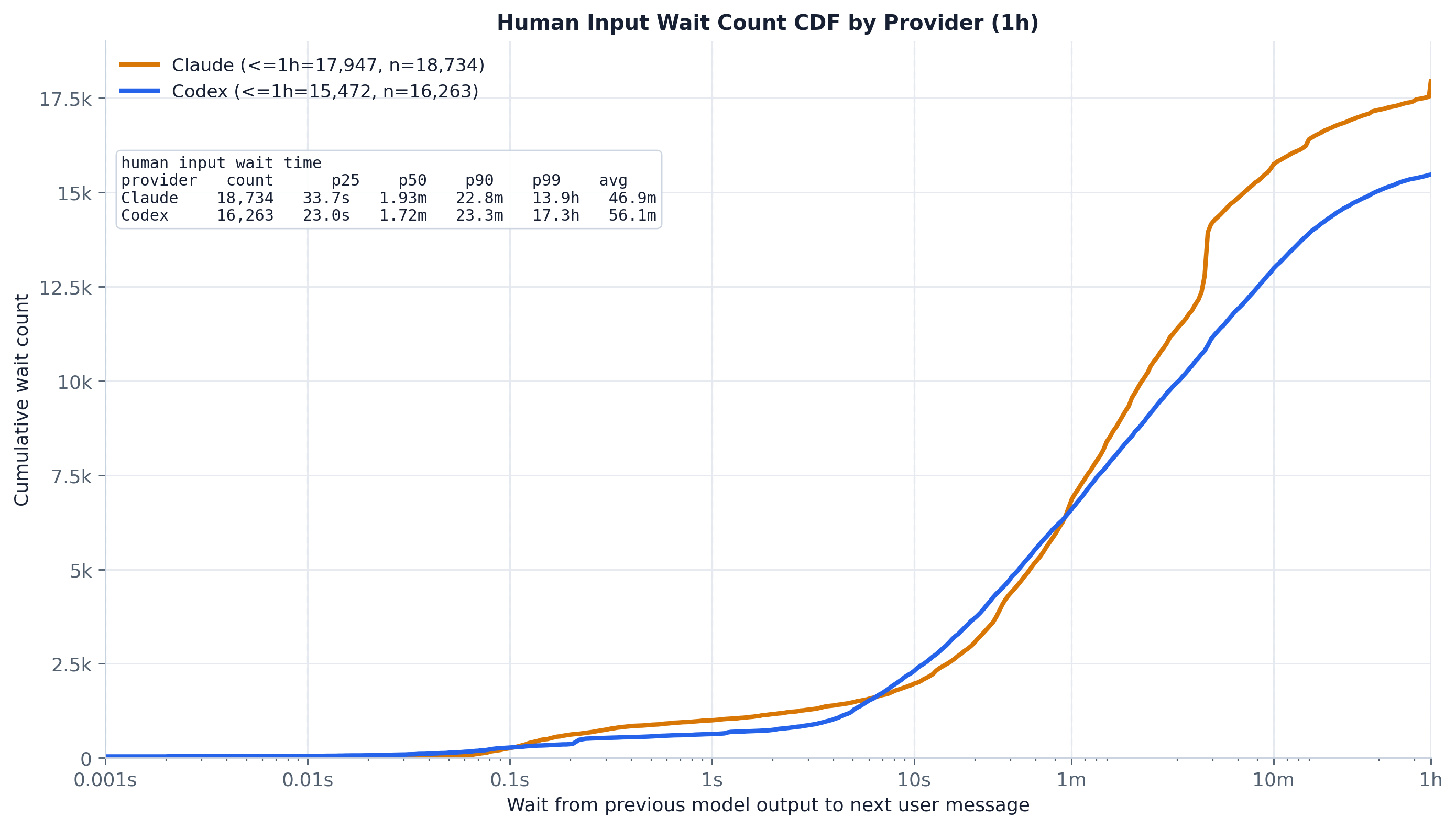
By count, most idle gaps are short — both curves rise early and are nearly saturated by the 1h cap. By the 5-minute eviction landmark 79.6% of Claude waits and 69.8% of Codex waits have already elapsed, and by 1h it is 96.4% / 94.9%. So roughly one reply in five (Claude) to one in three (Codex) takes longer than 5 minutes — long enough that the prefix is likely cold on the next request. Codex’s curve trails Claude’s throughout, consistent with its slightly longer typical wait. The in-figure table carries the per-provider percentiles and mean.
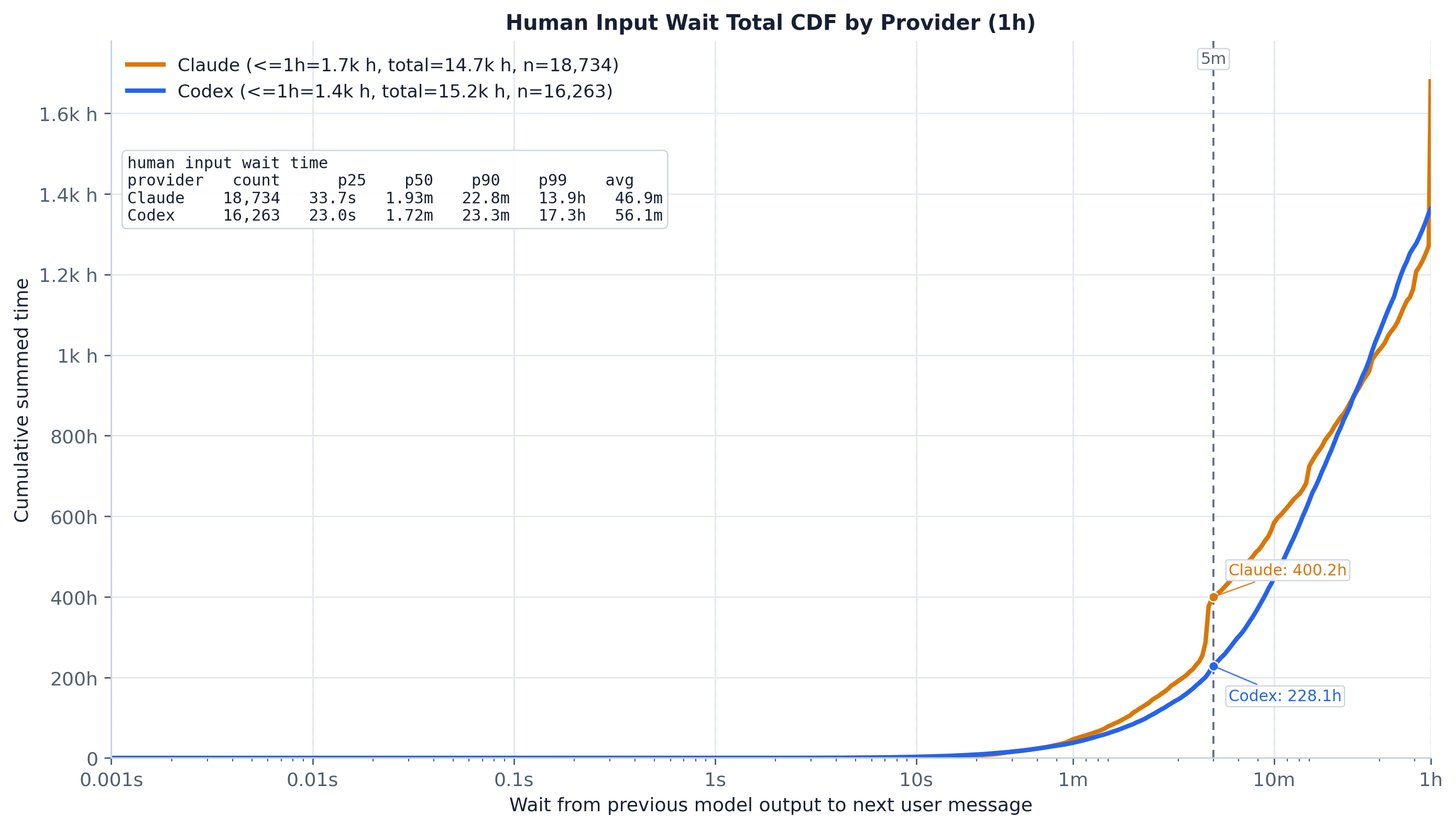
Weighting each wait by its duration flips the picture: the short gaps that dominate the count carry almost none of the time. By the 5-minute landmark — where ~70–80% of waits have ended — only 2.8% of Claude’s and 1.5% of Codex’s total idle time has accrued, and even by 1h the cumulative time share is just 11.6% / 8.9%. The remaining ~90% of all human idle time lives in waits longer than an hour, i.e. off the right edge of this 1h-capped axis. The huge gap between this curve and the count CDF is the headline: a tiny minority of very long gaps owns essentially all of the idle wall-clock, so cache-retention decisions are governed by the tail, not the median.
Human input wait is the gap, within one session, from the previous event of any type to each
user_message. It is provider-agnostic (the shared timing.human_waits_from_event_pairs): the gap
spans non-output events such as Codex usage_report, and every user message counts, not only
turn-triggering ones. It is computed by a stateful single-pass walk over agent steps in ingestion
order (round_pk == file order), keeping last_event_at_by_session: {session_id -> datetime}. For
each step, in event time order:
user_message event with a recorded previous-event timestamp prev for the session,
the wait is (user_ts − prev).total_seconds(); when strictly positive it is appended to the
"all" list and to that step’s provider bucket.prev advances to every event’s timestamp as the walk passes it (so consecutive user→user gaps
count too), carrying across rounds via last_event_at_by_session.This is a trace-level estimate, not a serving-engine timer; it reflects only recorded events. The wait spans the human think/read time between requests and excludes the model’s own generation.
Note (definition change). Earlier this metric used previous model output → response-triggering user message, which dropped non-trigger messages and Codex’s post-output
usage_reporttail — undercounting Codex idle (it surfaced elsewhere as an unattributed “Other” residual). The current provider-agnostic definition captures all human idle (Claude ≈ 90%, Codex ≈ 94% of session wall-clock).
The experiment renders the wait distribution three ways, with the x-axis on a log duration scale and the count/total panels capped at 1h (a 5-minute reference line marks a plausible cache-eviction horizon):
all and each provider;≤ T;≤ T.Method and assumptions:
all); the CDFs, percentiles, and summed-time bins run over the full set. The old loader already
kept every wait here — there was never a reservoir cap on this metric — so the migration is
value-for-value identical.round_pk (ingestion ordinal == file order), reproducing
the line-order tie-break the old single-pass JSONL loader relied on for its session state.str(provider) or "<unknown-provider>" fallback,
so a missing/empty provider falls into <unknown-provider>.CAST(epoch_us(timestamp) AS BIGINT)) and rebuilt to naive datetimes in Python, never fetched as
a raw TIMESTAMP (native duckdb marshals that to a datetime, duckdb-wasm to a string). A
difference between two same-timezone datetimes equals the naive-microsecond difference exactly, so
the waits match the pre-DuckDB result bit-for-bit.plot.py is a query→shape→plot pipeline over the shared trace DuckDB:
load_human_input_wait_seconds_by_provider(con) — the only data-loading code. It pulls per-step
timing_events (event_type + epoch-microsecond timestamp, in round_pk ingest order) and the
per-step (session_id, provider) from rounds, then runs the stateful walk above, returning
{"all": [...], provider: [...]}. The full per-provider lists are returned, no sampling.timing.human_waits_from_event_pairs(...) — the shared, provider-agnostic core (imported from
artifacts/utils/timing.py): given a session’s (event_type, timestamp) pairs and the carried
previous-event time, it walks them in time order and returns the positive previous-event→user_message
waits. The same helper backs the row-dict consumers (trace_loader, overview_summary), so every
path computes identical waits._epoch_us_to_datetime(...) — rebuilds a naive datetime from epoch-microseconds.ordered_human_wait_items / human_wait_summary_row / plot_human_input_wait_cdf /
write_human_input_wait_summary — shape the overlay CDF and the summary CSV (unchanged from the
pre-migration script).cdf.py helpers
(plot_count_cdf_by_provider / plot_cumulative_duration_cdf_by_provider and their write_*
counterparts) — matplotlib/CSV behavior unchanged.main() — wires the standard trace_db CLI (--db | -i/--input | -o/--output-dir) and embeds
the self-contained PNG sidecar.The data layer (parsing, surrogate keys, schema) lives in artifacts/utils/trace_db.py; see
artifacts/utils/DB_SCHEMA.md.
# default merged trace, output next to this README
uv run python artifacts/human_in_the_loop/human_input_wait/plot.py

# a specific trace (materialized to a temp DuckDB cache on first use)
uv run python artifacts/human_in_the_loop/human_input_wait/plot.py -i trace/sample.jsonl

# a prebuilt DB (run_all.py's build-db step passes this), into a chosen dir
uv run python artifacts/human_in_the_loop/human_input_wait/plot.py --db "$TMPDIR/trace.duckdb" -o "$TMPDIR/out"
human_input_wait_cdf.png — single-axis wait CDF overlaying all and each provider, with
n/p50/p90 in the legend.human_input_wait_count_cdf_by_provider.png / .csv — per-provider count CDF over the wait
threshold (waits ≤ T), with per-bin and cumulative counts/shares.human_input_wait_total_cdf_by_provider.png / .csv — per-provider summed-idle-time CDF, with
per-bin seconds/hours and cumulative time shares.human_input_wait_summary.csv — per-group (all + providers) count, mean, p50/p90/p95/p99,
and max in seconds.Each PNG embeds this README, the CSVs above, and the plotting code (plot.py + shared
artifacts/utils/ modules) as compressed text chunks. Unpack with
uv run python artifacts/utils/png_sidecar.py extract <png>.