
How long does a single agent step’s observable model generation take, and how is total generation time distributed across fast vs. slow steps?
How long does a single agent step’s observable model generation take, and how is total generation time distributed across fast vs. slow steps?
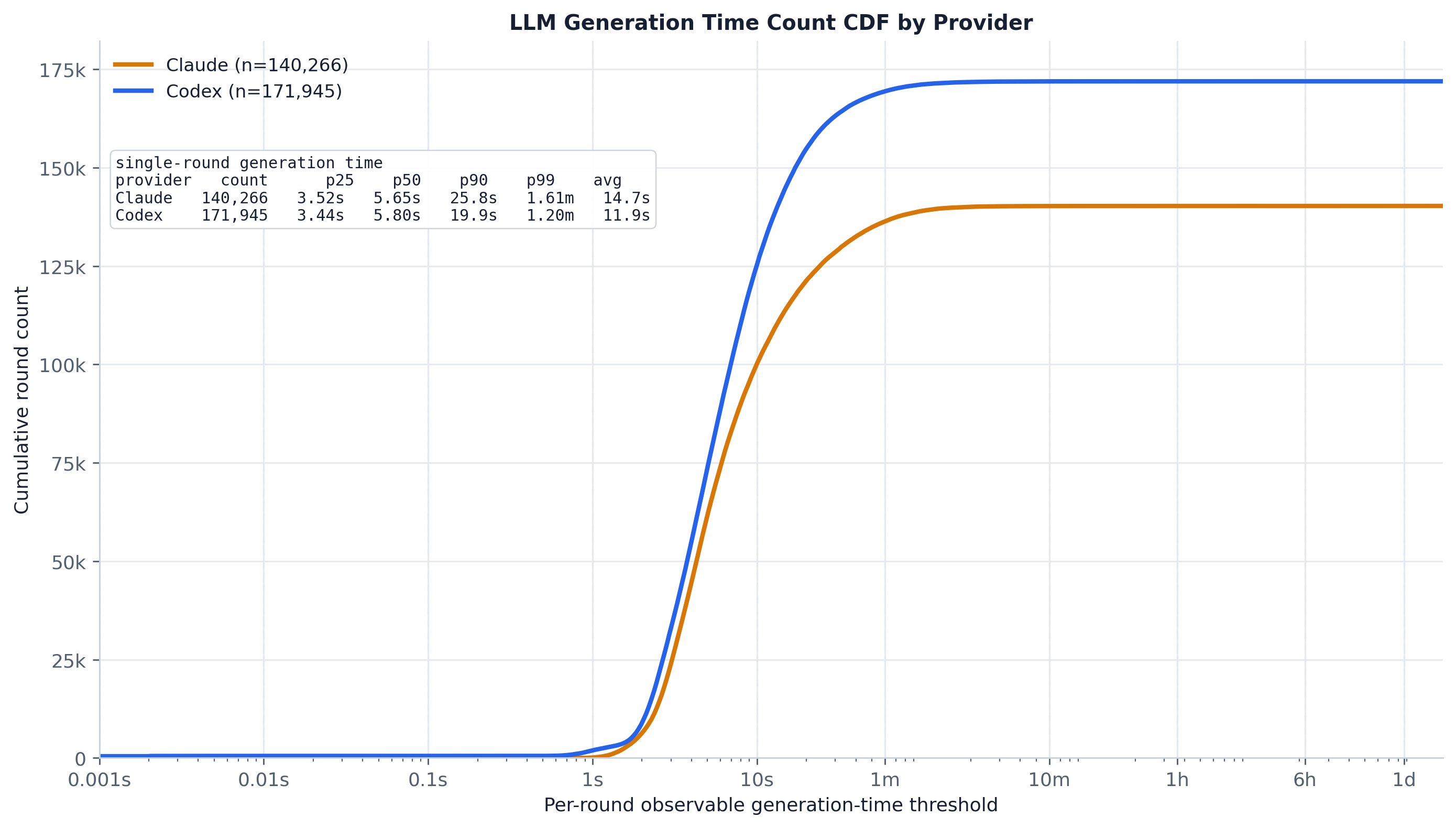
Per-provider cumulative count of agent steps against the observable generation-time threshold, on a
log time axis. Read where each curve reaches a given height to compare how fast steps finish: an
early-rising curve means most steps generate quickly, while a long flat tail to the right marks the
slow minority. The in-figure table carries the actual p25/p50/p90/p99 and mean per provider, and the
dashed landmark lines anchor familiar durations (a second, a minute) so the percentiles are easy to
place. This is the trace-observed span (latest input event to last model output), not a serving-engine
timer, so it folds in TTFT, reasoning, and trace-logging effects.
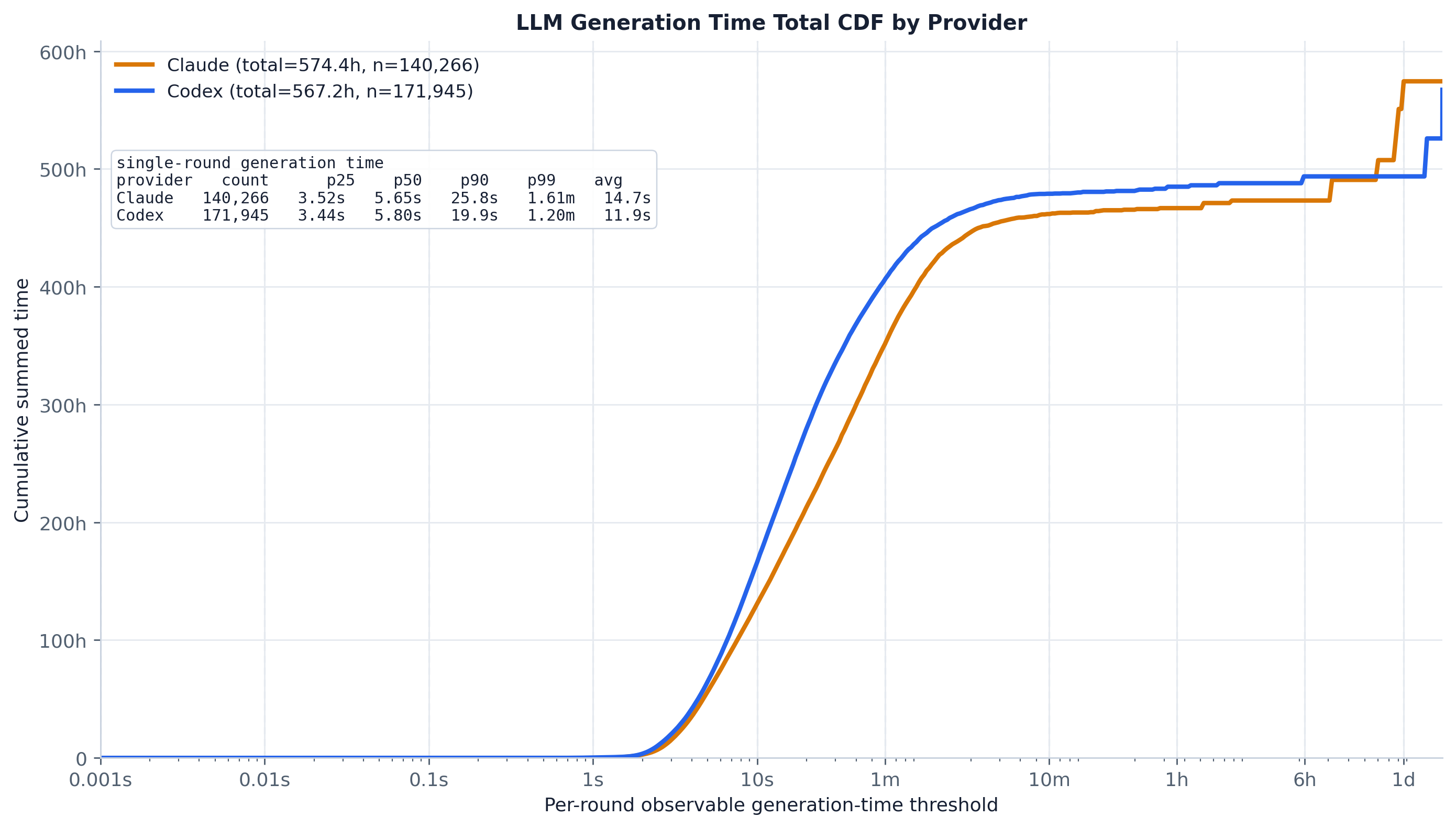
The same per-step spans, but each step now contributes its duration rather than one unit, so the
curve traces cumulative summed generation time (in hours) up to threshold T — i.e. where the wall
time actually goes. Because slow steps carry disproportionate time, this curve saturates much later
than the count CDF: a small tail of long steps dominates the total. The gap between the two figures is
the takeaway — the wider it is, the more concentrated that provider’s time spend is in its slow tail.
The observable generation time of an agent step is the span from its latest input event
(user_message or tool_result) to its last model-output event (reasoning, text, or
tool_call), taken from the step’s ordered timing_events[]. Concretely, per step: take the
earliest model-output timestamp as first_output; of the input timestamps, keep only those
at-or-before first_output (the inputs that could have triggered this output); the span is
(latest output - latest such input), kept only when strictly positive. Steps with no input or no
output events, or with a non-positive span, contribute nothing.
This is a trace-level estimate, not a serving-engine timer. It excludes the preceding human wait and any post-response usage-accounting events, and it can only reflect events the trace actually recorded.
The experiment renders two complementary CDFs over a per-step generation-time threshold T, paneled
by provider on a fine log-spaced duration axis:
≤ T.≤ T, i.e. where the wall time actually goes.Method and assumptions:
str(provider) or "<unknown-provider>" fallback, so
a missing/empty provider falls into <unknown-provider>.CAST(epoch_us(timestamp) AS BIGINT)) and rebuilt to naive datetimes in Python, never fetched as
a raw TIMESTAMP (native duckdb marshals that to a datetime, duckdb-wasm to a string). A span
between two same-timezone datetimes equals the naive-microsecond span exactly, so durations match
the pre-DuckDB result bit-for-bit.plot.py is a query→shape→plot pipeline over the shared trace DuckDB:
load_generation_seconds_by_provider(con) — the only data-loading code. It pulls per-step input
and model-output timestamps from timing_events (as epoch-microsecond ints, in round_pk ingest
order) and the per-step provider from rounds, then computes the observable span per step and
appends it to that provider’s list. The full per-provider lists are returned, no sampling._input_to_last_output_span_seconds(inputs, outputs) — reproduces the pre-DuckDB
timing.input_to_last_output_span_seconds for one step’s events (first-output gate, candidate
inputs, positive-span filter)._epoch_us_to_datetime(...) — rebuilds a naive datetime from epoch-microseconds.cdf.py helpers
(plot_count_cdf_by_provider / plot_cumulative_duration_cdf_by_provider and their
write_* counterparts) — matplotlib/CSV behavior unchanged from the pre-migration script.main() — wires the standard trace_db CLI (--db | -i/--input | -o/--output-dir) and embeds
the self-contained PNG sidecar.The data layer (parsing, surrogate keys, schema) lives in artifacts/utils/trace_db.py; see
artifacts/utils/DB_SCHEMA.md.
# default merged trace, output next to this README
uv run python artifacts/llm_generation/generation_time_cdf/plot.py

# a specific trace (materialized to a temp DuckDB cache on first use)
uv run python artifacts/llm_generation/generation_time_cdf/plot.py -i trace/sample.jsonl

# a prebuilt DB (run_all.py's build-db step passes this), into a chosen dir
uv run python artifacts/llm_generation/generation_time_cdf/plot.py --db "$TMPDIR/trace.duckdb" -o "$TMPDIR/out"
llm_generation_time_count_cdf_by_provider.png / .csv — per-provider count CDF over the
generation-time threshold (steps ≤ T), with per-bin and cumulative counts/shares.llm_generation_time_total_cdf_by_provider.png / .csv — per-provider summed-time CDF, with
per-bin seconds/hours and cumulative time shares.Each PNG embeds this README, the CSVs above, and the plotting code (plot.py + shared
artifacts/utils/ modules) as compressed text chunks. Unpack with
uv run python artifacts/utils/png_sidecar.py extract <png>.